Monday, 16 November 2020

The mysterious origins of George Taylor (1849-1903)

My grandfather was William Taylor (1890-1972). His father was George Taylor, the subject of this article. I have several records giving information about George’s life after his marriage in 1877, but can find nothing about his life before then.

George married Margaret Smiles on February 21st 1877 at Newcastle Registry Office. George is shown as aged 27, a bachelor. He was a Driver in the Royal Artillery and his address was Newcastle Barracks. His father is shown as Daniel Taylor, an innkeeper. I can’t find George in the 1881 census. He was probably was serving in India when the census was compiled (his daughter Harriett Jane was born there in December 1881). If so, he wouldn’t have been recorded in the census.

George left the army in 1886. The 1891 census shows George and his family living in West Street, Charlton. He is listed as aged 41, a labourer. The writing of his place of birth is unclear but seems to be Kelvedon (or Kelberdon), Essex.

In 1901 George and his family were still in West Street, Charlton. The census shows that George was aged 50, a local board labourer. His place of birth is again unclear – it could be Kelvedon (or perhaps Kesherdon or Heshidon), Essex.

George died on 29 August 1903. His age is shown as 54 in the death record index. There is a separate article on this blog describing the circumstances of his death.

His marriage certificate and the 1891 census indicate that George was born in 1849 or 1850. The 1901 census indicates 1850 or 1851. His death record indicates 1848 or 1849.  So his actual date of birth seems to be sometime between 1848 and 1851, probably 1849 or 1850.

The 1891 and 1901 censuses say that George was born in Essex. The place of birth appears to be Kelvedon (Kelberdon, Kesherdon and Heshidon don’t exist). Kelvedon was in the Witham Registration District when George was born. Unfortunately, FreeBMD shows no George Taylor births in Witham between 1848 and 1851 (or indeed between 1845 and 1855).

I have been unable to find George with his father Daniel in the 1851, 1861 or 1871 census. I have also been unable to find George's army record.

It is quite possible that the father’s name given on George’s marriage certificate is fictional. Perhaps George was born to an unmarried mother. If so, he probably didn’t know who his father was. He may have made up a name and occupation for the marriage certificate to avoid embarrassment. This was quite commonly done and no checks were made.

If anyone can help solve this mystery, please let me know.   

Thursday, 5 March 2020

Cissy (Cissie) Amelia Barker nee Cornwell (1901-82)

The following item was kindly supplied by Karen, who I made contact with as a result of our Ancestry DNA test results showing a partial match. Cissy was a grand-daughter of George Cornwell (1840-1912), who was a brother of my ancestor Jane Wilkins nee Cornwell (1851-1934). Karen writes:

“My grandmother Cissy Amelia Cornwell was born on the 7th December 1901 at Constance Road Workhouse East Dulwich. Her mother Emma Amelia Cornwell was admitted to the workhouse on the 2nd of December. It states in the records that Emma was admitted from the parish of Camberwell. On Cissy’s birth certificate it gives Emma’s occupation as sewing machinist and her address of 108 Lower Park Road. The name of Cissy’s father is not given, indicating that Emma was not married to him. The birth was registered on the 21st December 1901.  Cissy was baptised on the 21st December 1901 in the parish of Camberwell.

There had always been rumours in the family that Cissy was ‘adopted’ by Alfred Sampson, the gatekeeper at the workhouse. On the 1901 census Alfred Sampson is shown as the gate porter at Camberwell infirmary. Alfred and his wife Harriet took Cissy in. At this time, child adoption was an informal procedure (it had no legal status in England until 1926). Alfred and Harriet had two of their own children, a son Norman and a daughter Lilian who were 13 and 11 when Cissy moved in with them. We are not sure whether the Sampsons might have been paid to look after Cissy. On the 1901 census Harriet Sampson is shown as living at 43 Fenham Road, Peckham with Norman and Lilian.

Emma Cornwell discharged herself from the workhouse on the 28th December 1901 at her own request, leaving Cissy behind. The next record I found for Emma was a marriage entry on December 25th 1904 at St Andrew’s Peckham in Camberwell. She married Harold John Scott an upholsterer aged 22. Emma gave her age as 25 (she was in fact 32). Emma’s address was 21 Fenham Road, which is interesting, as The Sampsons were living at number 43 in 1901. The witnesses at the marriage were Emma’s parents George and Louisa Cornwell. Emma and Harold had 3 children, Harold John Scott 1905-1990, Roma Sybil Scott 1907-2003 and Netta Irene Scott 1909-1998.

In the 1911 census Cissy (now showing as Cissie which is how my nan always spelt her name) is living with Alfred, Harriet, Norman and Lilian Sampson and Alfred’s brother Ernest at 24 Calverley Grove in Upper Holloway. Cissie, aged 9, is shown as an adopted child. Alfred, aged 50, was a motor car cleaner at a motor repair works. He was very kind to her and Cissie thought the world of him. Cissie had no interest in who her birth parents were.

We’re not sure what school Cissie attended but she had learnt to play the violin and had earned her life saving badge. Cissie knew she was born in a workhouse and had a real fear of ending up in an institution again.  

Her first job was as an apprentice dressmaker at Liberty’s of London. She started by picking up the pins from the floor for the dressmakers and became a very accomplished dressmaker and embroiderer. Cissie was often required to deliver dresses to clients. We presume she worked at Liberty’s until she married in 1924.


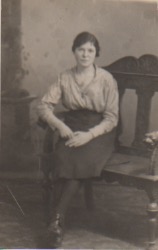
Cissie as a young woman

Cissie married George Henry Barker on September 21st 1924 at the Parish Church Albany Street, St Pancras. She was aged 22, he was 25, a motor mechanic. George and Cissie met as they lived at the same address, 66 William Street, St Pancras with their families. The earliest electoral register that I can find showing the families living there is 1921.

George and Cissie Barker

Cissie and George’s only child, a daughter, was born in 1933 in St Pancras. The 1939 Register shows them living at 6 Frideswide Place in St Pancras. George was a motor mechanic and driver and Cissie’s occupation is listed as unpaid domestic duties.  

The family later moved to East London, where the family lived during WW2. They were ‘bombed out’ several times, which is the main reason there are so few photographs of them. Before one particularly bad raid, they went to stay at the house of Austin Reed, who my grandfather worked for. When they returned to their property, it had gone. Their daughter was evacuated to Bedfordshire. In 1944 Cissie joined her daughter and took Alfred Sampson, who was by then completely blind, with her. He died there in 1944, aged 83. That was when my mum first found out that Cissie was adopted, as the rest of the family said it wasn’t fair that Cissie had to pay towards the funeral costs for Alfred as she was adopted.

Cissie and George were not well off and lived in a series of properties, usually consisting of a couple of rooms with outside lavatory, an oven on the landing and no washing facilities. Bathing consisted of a weekly trip to the public baths. My mum remembers the horrors of bed bugs!

One of my favourite memories of my nan, and it’s only a simple one, is when she used to stay with us at the weekends. Every Sunday morning she’d bring us tea and biscuits in bed. A luxury I still enjoy! She enjoyed watching the wrestling on a Saturday and listening to music. Nan had a lot of patience with me. She tried to teach my very left-handed self to crochet, not an easy task as I did most of it backwards! Nan took me to see The Sound of Music when it came out. We enjoyed it so much that we sat through it again (when cinemas allowed you to do this). As nan lost her sight in the advanced stages of glaucoma, one of her greatest pleasures was listening to talking books. She never wanted to be a burden to anyone. She was lovely.

Cissie and George lived in London until his death in 1967 aged 68. Cissie then moved to Hayes in Middlesex to be closer to her family. She continued to work well into her 70s in the restaurant at the local cottage hospital.

Cissie died in hospital on the 12th April 1982 aged 80. A good age for someone who had a tough beginning. She was cremated at Breakspear Crematorium in Ruislip.”

Thursday, 2 January 2020

George Cornwell (1840-1912)

George Cornwell was a brother of my great grandmother Jane Wilkins nee Cornwell (1851-1934). He was born in 1840 in Kelvedon, a village in Essex, and baptised there on 27 September 1840. He was the second child of George Cornwell (1817-1907) and his wife Elizabeth nee Frankling (1818-89) who married in 1838 in Kelvedon and went on to have 10 children (5 boys and 5 girls). At least 3 of these children died young.

The census in April 1841 lists George Cornwell, an agricultural labourer aged 25 in Kelvedon living with his wife Elizabeth (24) and their children Charles (3) and George (1).

The 1851 census shows George and Elizabeth Cornwell living in Kelvedon with their children Charles (aged 12), George (10), Elizabeth (8), and Henry (3).

In 1861, George and Elizabeth are listed at High St, Kelvedon with their children George (now aged 20 and a blacksmith), Henry (12), Jane (9) Rebecca (6) and William (2).

George Cornwell junior moved to London sometime between 1861 and 1865. On July 1st 1865 he married Louisa Charlotte Hoppet at Christ Church, St Pancras. He was aged 25 and a farrier (a blacksmith who fits shoes to horses). She was aged 24 (born 1841 in Marylebone), a daughter of Israel Hoppett, a labourer, and his wife Charlotte Jubilee nee Polley.

George and Louisa went on to have seven children namely Louisa Jane (born 1866 in Marylebone), Rebecca Charlotte (born 1868 in Marylebone), Elizabeth Jubilee (born 1870 in Marylebone, died 1871), Emma Amelia (born 1872 in Marylebone), Mary Elizabeth (born 1875 in Marylebone, died 1876), Elizabeth (born 1879 in Camberwell) and George Henry (born 1882 in Camberwell).

The 1871 census shows George Cornwell, aged 30, a cellarman, living at 157 Cleveland Street, Marylebone with his wife Louisa (29) and children Louisa (4), Rebecca (2) and Elizabeth (7 months). A cellarman is a person who works in a cellar where wine or beer is stored.

George and his family seem to have moved from Marylebone (in North East London) to Camberwell (in South East London) sometime between 1875 and 1879. The 1881 census lists George as a drayman, aged 40, living at 5 Bedford Cottages, Bedford Street, Camberwell. Also at this address was George’s wife Louisa (aged 39) with his daughters Emma (7) and Elizabeth (1). A drayman is someone who drives a dray, a large flat cart with four wheels, pulled by horses. It was often used to deliver beer.

The census in 1891 lists George, aged 50, a carman (a driver of a cart) living at 63 Waghorn Street in Camberwell with his wife Louisa (50) plus children Elizabeth (10) and George (8).

Charles Booth (1840-1916), undertook an Inquiry into the Life and Labour of the People in London, between 1886 and 1903. It contained information on housing conditions in London. Waghorn Street was surveyed in 1899. The notebook entry says Waghorn Street. 2 story, 6 to 8 rooms. Some let at 14 shillings per week. 2 families, labouring people. Houses badly kept. Trade notices in windows. A few shops at south end. Booth produced maps of London where each road was colour coded according to the people who lived there. There were 7 categories ranging from Lowest class. Vicious, semi-criminal (black) to Upper-middle and upper classes. Wealthy (yellow). Waghorn Street was classified as Mixed. Some comfortable others poor (purple), which was the fourth of the seven classifications. The current 63 Waghorn Street is a 2 storey house which looks like it was built before 1891 and seems to be the property that George and his family lived in.

In 1901 George was living at 108 Lower Park Road in Camberwell. He is listed as aged 60, a carman employed by an iron foundry. Also in the household were his wife Louisa (60) and son George Henry (19, a tin plate worker).

George’s father died in 1907. George was left a quarter share of his father’s estate of £121 15s 1d (equivalent to about £47,000 now).

In 1911 George (aged 70, a general carman out of employment) and Louisa (69) were living at 37 Fenham Road, Peckham. The census return says that they occupied 3 rooms, had been married for 46 years and had 7 children, of which 4 were alive and 3 were dead.

George died in 1912 aged 71. He was buried on 12 April 1912 in a cemetery in Southwark. His wife died in 1913 aged 72.

Monday, 23 December 2019

My DNA Test

Last year, I decided to take a DNA test to help with my family history research. There are several companies that offer DNA testing, but Ancestry has by far the biggest database of DNA results (from more than 15 million people), so I chose them. I bought the test on Black Friday (23 November 2018), when the normal price of £79 was reduced to £49. There was also a £10 charge for shipping. More information about the test is at https://www.ancestrydna.co.uk/kits?&&pgrid=49763045925&ptaid=kwd-297622641345&s_kwcid=ancestry%20dna&gclid=EAIaIQobChMI3s7Jgb-b4gIV65ztCh03cA_yEAAYASABEgLY__D_BwE&gclsrc=aw.ds

I received the test kit in the post soon after ordering it, but didn’t send off my sample (saliva) until January 2019. I was sent my results online about 6 weeks later. Ancestry provide a list of the names of DNA matches and the amount of DNA you share, under headings indicating how close the relationship is. I had one match under the second cousin heading, 4 third cousins and 190 fourth cousins (this category actually covers fourth to sixth cousins). Second cousins share a set of great grandparents, third cousins share a set of great, great grandparents, fourth cousins share a set of great, great, great grandparents. The list of matches is added to as more people are tested – I now have 2 second cousins, 7 third cousins and 235 fourth cousins.

In order to get the most benefit from a DNA test, you should enter the names and dates of your ancestors and link this information to your name on the Ancestry DNA site. If a DNA match has attached their family tree, the site will highlight surnames that are in your tree and their’s. It is then often apparent who the shared ancestor is. The system also lists the names of shared matches. If you know how a name on this list is related to you, then others on it are probably related via the same line. The system also allows you to send a message to your DNA matches.

The results from my DNA test were not as useful as I hoped. I had previously made contact with 8 of my DNA matches before I got the results. Only 36% of other DNA matches that I contacted replied to my message to them. Only 15 of my closest 50 matches had attached a family tree that I could view. Consequently, I wasn’t able to establish how a lot of my DNA matches are related to me. However, I made some good contacts who have supplied me with information and pictures that I have added to my family history blogs.

There is a useful article on how to make the most of your DNA results at  https://www.lostcousins.com/newsletters2/wedding18.htm#Masterclass

There were 11 DNA matches where I was able to establish a definite link to my father’s family. Two of them were second cousins descended from great grandparents George and Margaret Taylor. One was descended from my grandfather’s brother Samuel Taylor and the other from my grandfather’s sister Margaret Ellen Smith nee Taylor. There were also two third cousins who were descended from my great, great grandparents George and Elizabeth Cornwell. One was descended from their son George Cornwell and the other from their daughter Elizabeth Harling nee Cornwell.

The test also provides an ethnicity estimate, by comparing DNA results with those of people in various regions throughout the world. These estimates are of dubious value and accuracy. In my case, my ethnicity was estimated as 88% from England, Wales and Northwestern Europe, with most from the East of England, 5% from Norway, 5% from Ireland or Scotland and 2% from Germanic Europe. All of the ancestors that I have found from my research were born in England, with quite a few born in Essex. I am not aware of any ancestors born in Norway, Ireland, Scotland or Germanic Europe.

Tuesday, 12 November 2019

George Taylor (1877-1953)

George Taylor was my great uncle. He was the eldest brother of my grandfather William Taylor (1890-1972). Their parents were George and Margaret Taylor, who had 12 children, 8 boys and 4 girls. Their son George was born on 16th July 1877 in Newcastle, whilst his father was serving in the Royal Artillery there. It seems that George senior took his wife and family with him to his various postings (including India in 1881) so George junior would have had a rather unsettled childhood.

George senior left the army in 1886 and the family moved to Charlton. The 1891 census shows George Taylor (aged 41, a labourer) and Margaret (36) living at 9 West Street, Charlton with their children George (14), Ernest (12), Harriet (9), Charles (6), Margaret (4) and Thomas (2) and William (10 months). Thomas died in 1898 aged 9.

By 1901 the family were living at 7 West Street, Charlton and consisted of George (aged 50, a labourer local board), Margaret (47), George (24, a covering machinist), Jane (19, a covering machinist), Charles (16, a covering machinist), Margaret (14, a daily servant), William (10), Samuel (9) and May (6).

George married Kate Elizabeth Lambert on 30th March 1902 at West Green Baptist Chapel, Tottenham. The marriage certificate shows him to be aged 25, a wood machinist. She was also 25, a daughter of Leonard Lambert who was a gas fitter. The witnesses were Charles Taylor (a brother of George) and Ada Lambert.

Marriage certificate of George Taylor

George and Kate had a son, George Edward Taylor who was born on 23rd August 1904 in Woolwich. He was baptised on 7th March 1905 at Holy Trinity Church, Charlton. The baptism record shows the family’s address as 18 James Street, Woolwich and George’s occupation as insurance agent. Sadly, the boy died later that year, before his first birthday.

The 1911 census shows George (33) and Kate (33, born in Dalston) living in three rooms at 6 Inverine Road, Charlton (near Charlton station). By then George was an insurance superintendent. Considering that George came from a poor background, this sounds like good career progress. They had three children, William Leonard (3), Kate Margaret Annie (2) and George Charles (1), all born in Marylebone. George Charles Taylor died in Q2 1911. Another child, Ernest Walter, was born later in 1911. He died aged 3 in 1915 and is buried in Charlton Cemetery.

6 Inverine Road, Charlton (in 2012)

The 1928 to 1939 electoral registers show George, Kate and William living at 31a Inverine Road in Charlton. In 1931 and 1932 Kate Margaret Taylor (their daughter) was living at 31 Inverine Road. She died in 1933 aged 25. The 1939 Register shows George (a builder's watchman), Kate and William at 31a Inverine Road.

William died in 1943 in Greenwich aged 35. This meant that all five of George and Kate’s children died before they did.

31 and 31a Inverine Road, Charlton (in 2012)

George and Kate lived at 31 Inverine Road from 1945 to 1950, when Kate died aged 72. She is buried in grave R / 241 in Charlton Cemetery with her children Kate and William. The kerbstones round the plot are engraved
In loving memory of our dear daughter KATE MARGARET ANNIE TAYLOR ….. ….. ….. /
Also our dear son WILLIAM LEONARD TAYLOR who died 24th March 1943 aged 35 years / KATE E TAYLOR, a beloved wife and mother, died 5th March 1950 aged 72.

George continued to live at 31 Inverine Road until he died in 1953 aged 75. He was buried on 7th March 1953 at Charlton Cemetery, not in the same grave as his wife and children (perhaps because it was full) but in grave Y / 735. I cannot find a probate record for him.

Tuesday, 29 October 2019

Ellen Smiles (1852-1929)

Ellen Smiles was the twin sister of my great grandmother Margaret Taylor nee Smiles (1852-1917). Ellen and Margaret were born on September 5th 1852 in Newcastle upon Tyne. Their parents were Jane Smiles and Alexander Maddison, who were not married.

The 1861 census shows William Smiles (aged 78, a cowkeeper), his unmarried daughters Jane (38, a housekeeper) and Mary (28) plus Jane’s daughters Margaret (7) and Ellen (7) living at 3 Liverpool Court, Newcastle.

Ellen married Joseph Scragg on December 20th 1875 at St Andrew’s, Newcastle. She was aged 23. He was aged 31, a soldier in the Royal Artillery. He originated from Prestbury in Cheshire. They went on to have five children, namely William Joseph (born 1876 in Newcastle), Samuel (born 1878 in Weedon, Northants), Thomas (born 1880 in Aldershot), Jemima (born 1882 in Trowbridge) and May (born 1884 in Macclesfield). The birth places of the first four children probably reflect the location of army barracks where Joseph was sent to. The 1881 census shows Ellen and her family living at the Royal Artillery Barracks, Aldershot.

Ellen Scragg nee Smiles, one of her children (William Joseph?) and her husband Joseph c1879 (photo supplied by Rosslyn Hughes).

Joseph Scragg was an Army pensioner and general labourer in 1885 when he died in Macclesfield aged 41, as a result of a thoracic aneurism. Ellen married John James Williams, another soldier, in 1886. She was 33, he was about 32 and came from Manchester. They had three children, John James (born 1887 in Colchester), Albert Edward (born 1890 in Whittingdon, Staffordshire) and Ellen (born 1896 in Newcastle).

The 1891 census shows Ellen, her husband John (a Private in the Infantry) and seven children living at Whittingdon Barracks, Staffordshire. By 1901, the family were living at 6 Douglas Terrace, Westgate, Newcastle. John had left the Army and was a builder’s labourer. In 1911, Ellen was living at 3 Neville Court, Newcastle (in 3 rooms) with her husband John (a labourer) her son William Joseph Scraggs (34, an insurance agent), daughter Ellen Williams (14) and grandchildren Lily Pretoria (11) and Margaret Scraggs (8), who were William’s children, their mother Hannah having died in 1908.

Ellen died in 1929 aged 76 in Newcastle.

Friday, 4 October 2019

Samuel Taylor (1892-1952)

Samuel Taylor was a younger brother of my grandfather William Taylor (1890-1972). This profile of Samuel’s life was written with the help of Amanda Butler, who is a great grand-daughter of Samuel and is one of the matches from my Ancestry DNA test.

Samuel was born on April 24th 1892 in Charlton, Greenwich. He was one of 12 children (8 boys and 4 girls) born to George Taylor (1849-1903) and his wife Margaret nee Smiles (1852-1917). George had left the British Army (he was a Bombardier in the Royal Artillery) in 1886 and the family set up home in West Street, Charlton, a road with poor quality housing.

The 1901 census shows Samuel living at 7 West Street, Charlton. The household consisted of George (aged 50, a labourer local board), Margaret (47), George (24, a covering machinist), Jane (19, a covering machinist), Charles (16, a covering machinist), Margaret (14, a daily servant), William (10), Samuel (9) and May (6). The house that Samuel and his family lived in no longer exists, but I have a map which indicates that it was fairly small. As 8 people lived there in 1901, it must have been crowded !

Samuel’s father George died in 1903. In 1909, Samuel, aged 17, joined the Territorial Army. His attestation form (on the website Findmypast) gives his address as 7 West Street, Charlton and his occupation as a labourer at Royal Arsenal (which was nearby in Woolwich). His height was 5 foot 2 inches, chest (expanded) 32.5 inches. He was passed fit to join the army and was assigned to the 8th London (Howitzer) Brigade. As a territorial soldier, Samuel received some initial training and 2 weeks of training each year. He was not in the army full time. He was discharged in 1913, having served the 4 years he signed on for. His discharge papers say that he was not wounded and did not take part in any campaigns during his service. They give his next of kin as his mother Margaret, 7 West Street, Charlton. She married Morris Samuels in 1911.

The 1911 census shows the inhabitants of 7 West Street to be Morris Samuels (62, a ships storekeeper’s labourer), Margaret Samuels (56), Charles (26), William (20) and Samuel (18) Taylor, all ammunition labourers (Charles at Vickers and Maxim, William and Samuel at Woolwich Arsenal).

Samuel (like other men of his age) fought in the 1914-18 World War. If he didn’t volunteer to join, he would have been conscripted into the armed forces (conscription was introduced in 1916). I can’t find a WW1 service record for him, but it may well be one of many that were destroyed by fire during the blitz in WW2.

Samuel’s mother Margaret died in 1917. That year, Samuel, aged 24, married Elizabeth Alice Taylor in Greenwich. She was born in Greenwich, aged 25, a daughter of Robert Taylor (a gas works labourer) and his wife Caroline. Samuel and Elizabeth had a son, Ronald Samuel Joseph in 1923 and another son, Edward Robert in 1926, both born in Greenwich.

The 1921 census shows Samuel, aged 29, a moulder working for Siemens Brothers in Woolwich and Elizabeth, aged 29, occupation "home duties", living at 22 Combedale Road, London SE10. The house (in Greenwich, near Westcombe Park train station) still exists, it is a mid terrace property on three floors. Samuel and Elizabeth occupied 3 rooms and presumably occupied one floor of the house.

Samuel Taylor c 1923, from a wedding photo
(the woman next to him is probably his wife Elizabeth).

The birth certificate of Ronald shows that Samuel and his wife were living at 5 Weetman Street in 1923. Samuel’s occupation is given as “engineer fitter and turner”. Electoral registers from 1924 to 1933 show Samuel and Elizabeth living at 5 Weetman Street, Greenwich. This road no longer exists but was on the western side of the Greenwich Peninsula, near the Blackwall Tunnel approach road.

By 1939, Samuel and his family were living in Croydon. The 1939 Register shows them living at 27 Croydon Grove, about 1 mile NW of central Croydon. The family consisted of Samuel (an ebonite moulder) and Elizabeth with their sons Ronald (a poster writer) and Edward (at school). Ebonite is a type of hard rubber.

Elizabeth died in 1946 aged 54 at The General Hospital, Croydon. Probate records give her address as 28 Croydon Grove. Administration (indicating that she did not leave a will) of her estate was granted to her husband Samuel, a painter, and her son Ronald, a private in the army. She left £5,030 12s 8d, which is equivalent to about £520,000 now, when calculated in relation to average wages.

Samuel died on July 17th 1952 aged 60 at Purley Cottage Hospital, Croydon. His death certificate says that he died from bronchopneumonia, but that the underlying cause was tuberculosis (a bacterial infection) in his left hip joint. It gives his address as 28 Croydon Grove and his occupation as “builder and decorator on own account.”

Samuel's will (made in 1946) appointed his sons Ronald and Edward as his executors. It left his gold dress ring to his son Edward. The two sons were left equal shares of the rest of his estate. Probate was granted to Ronald, a storekeeper and Edward, a fitter. The value of his estate was £1,519 18s 9d (equivalent to about £160,000 now).